
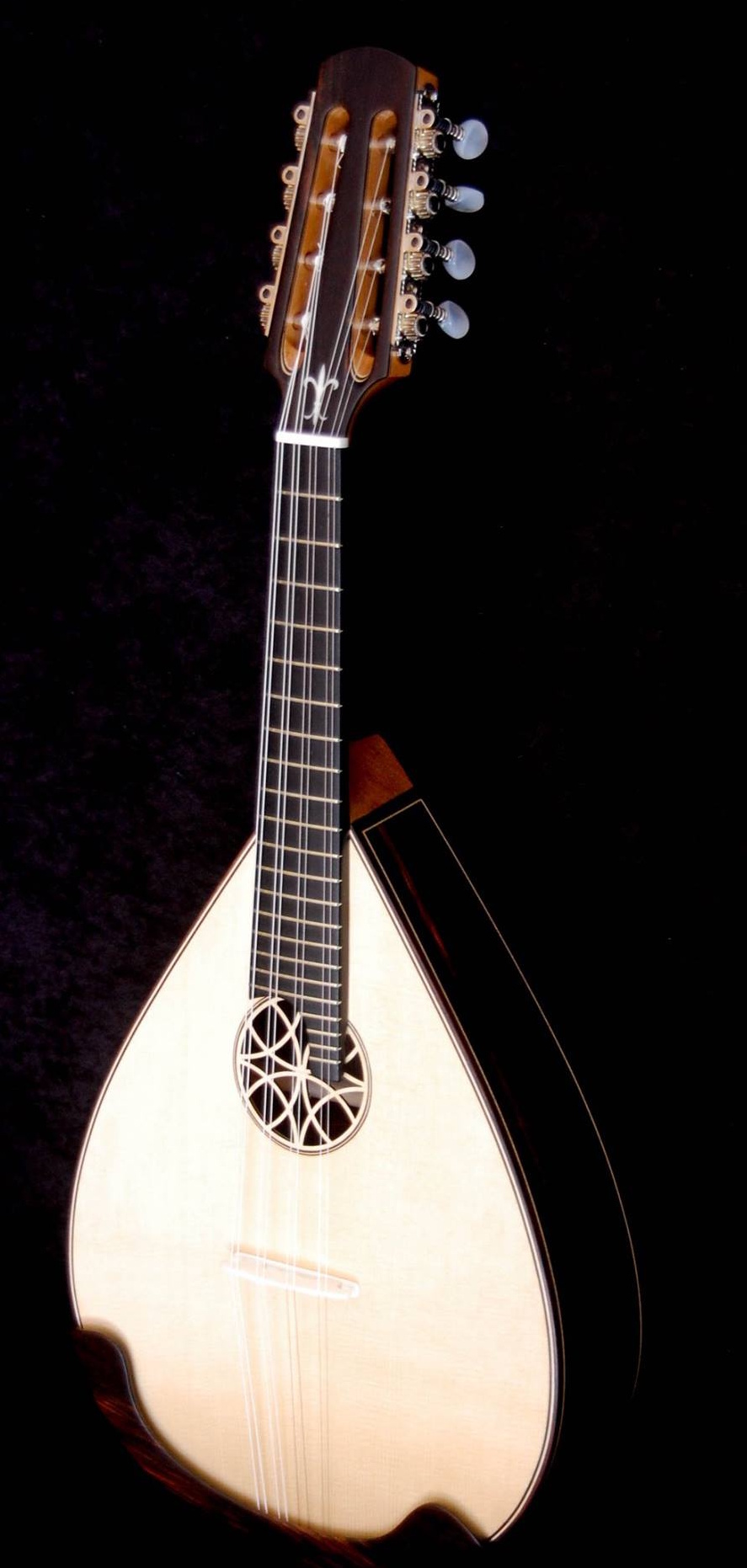
Portuguese Mandolin
Tradition and Elegance of Plucked Strings
The Portuguese mandolin is a plucked string instrument belonging to the lute family, with its presence in Portuguese musical tradition dating back to the 18th century. Inspired by Italian mandolins—particularly the Neapolitan mandolin—the Portuguese model gradually acquired its own characteristics, adapting to local musical tastes, repertoire, and national craftsmanship.
Instrument Characteristics
The Portuguese mandolin retains the classic rounded bowl-back shape (arched back made of wooden ribs), a trait inherited from its Italian predecessors. The soundboard is typically made of spruce, a wood that enhances clarity and brightness, while the back and sides are often crafted from fine woods such as rosewood, maple, or walnut. Its short scale and fine frets favor the execution of fast and ornamented passages.The most common tuning follows that of the violin family: G–D–A–E, with four pairs of double strings (8 strings in total), played with a pick. This tuning facilitates reading sheet music written for violin and allows for great melodic agility.
Context and Repertoire
The Portuguese mandolin is mainly used in chamber music ensembles, academic tunas, regional folk groups, and plucked string orchestras. It usually plays a melodic role, serving as a solo or featured instrument in traditional pieces, classical arrangements, or folk adaptations. It is also commonly found in academic and amateur settings, where it helps preserve the plucked string tradition in Portugal.Although it is not a central instrument in fado (where the Portuguese guitar takes precedence), the mandolin occasionally appears in instrumental arrangements or orchestrated versions, contributing its sweet and bright sound.
Artisanal Construction
The Portuguese mandolin continues to be handcrafted by specialized luthiers who preserve traditional techniques while incorporating modern innovations. Each instrument is unique, with special attention given to tonal balance, neck comfort, and sound projection. Portuguese craftsmanship keeps this art alive, valuing the instrument’s national identity.The Portuguese mandolin is a symbol of the elegance and richness of Portugal’s traditional string music. Though less prominent than some other instruments, it carries centuries of history, refined craftsmanship, and a crystalline tone that continues to enchant musicians and listeners. Its continued presence in cultural and academic groups ensures that its voice remains alive and relevant in the Portuguese musical landscape.