
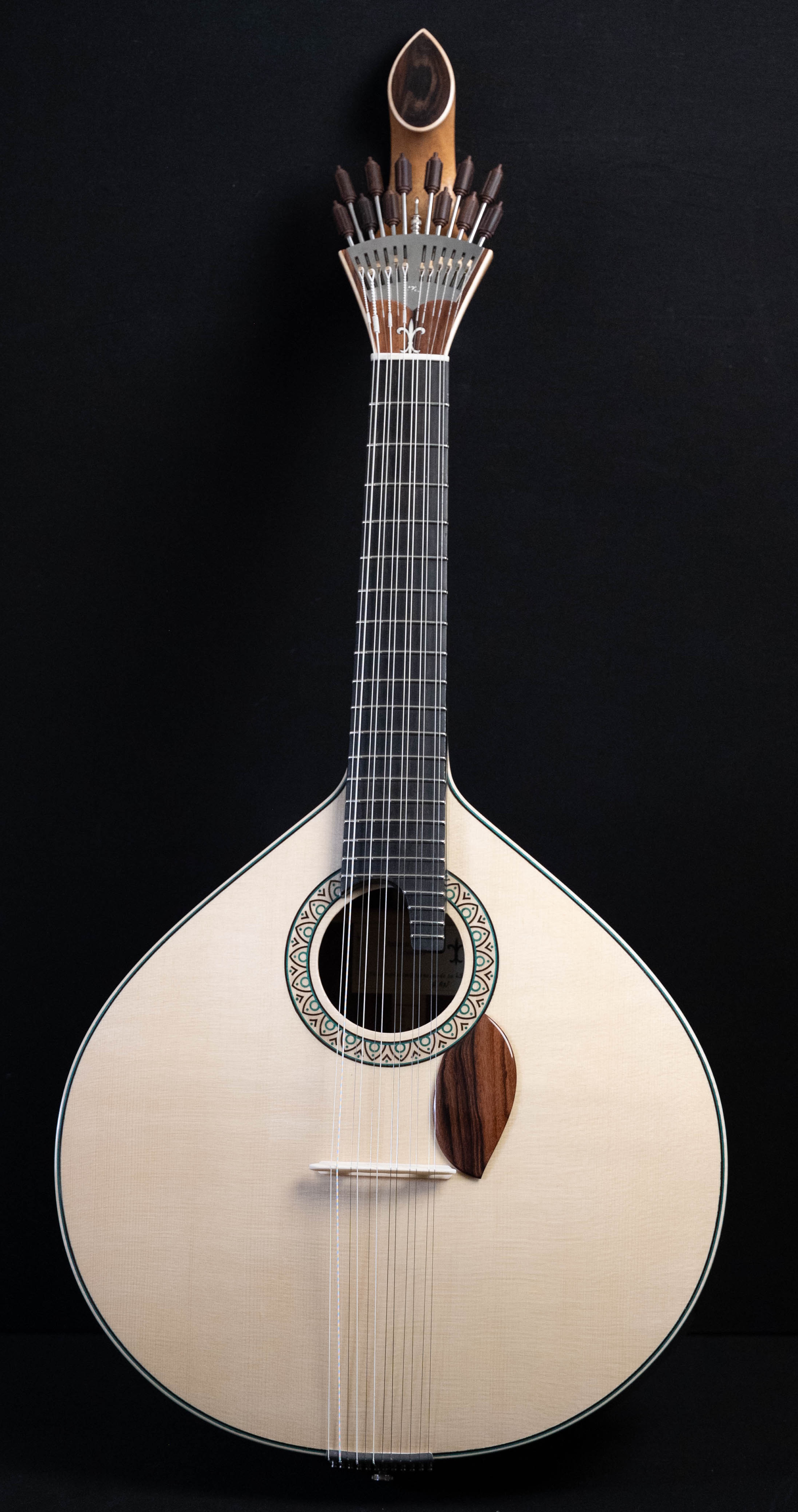
The Portuguese Guitar of Coimbra
The Portuguese guitar of Coimbra is an emblematic instrument of traditional Portuguese music, particularly associated with Coimbra Fado. This version of the guitar stands out both for its construction and the way it is played, reflecting the cultural and academic identity of the university city.
Physically, the Coimbra guitar is slightly larger than the Lisbon version and features a longer and narrower soundbox. Its neck is also longer, and the body is more rounded. The guitar’s scale is tuned to a lower pitch, usually in C, giving it a deeper, more melancholic, and introspective sound, in contrast to the brighter and higher-pitched tone of the Lisbon guitar.
A distinctive feature is the shape of the instrument’s headstock, often carved in the form of a teardrop or shield, reflecting the student and aristocratic heritage of the city of Coimbra. This particular aesthetic, combined with its dense and expressive sound, makes the Coimbra guitar an instrument deeply linked to academic tradition, often played in serenades and in contexts of tribute or reflection.
Regarding technique, the Coimbra guitar is generally played with a more restrained and meditative fingerpicking style, accompanying a deep male voice typical of Coimbra Fado, which is also distinguished by its more intellectualized and scholarly poetic and thematic content.
More than just a musical instrument, the Portuguese guitar of Coimbra is a symbol of identity and emotion, holding within its strings the bohemian, melancholic, and intellectual spirit that characterizes the city and its university.