
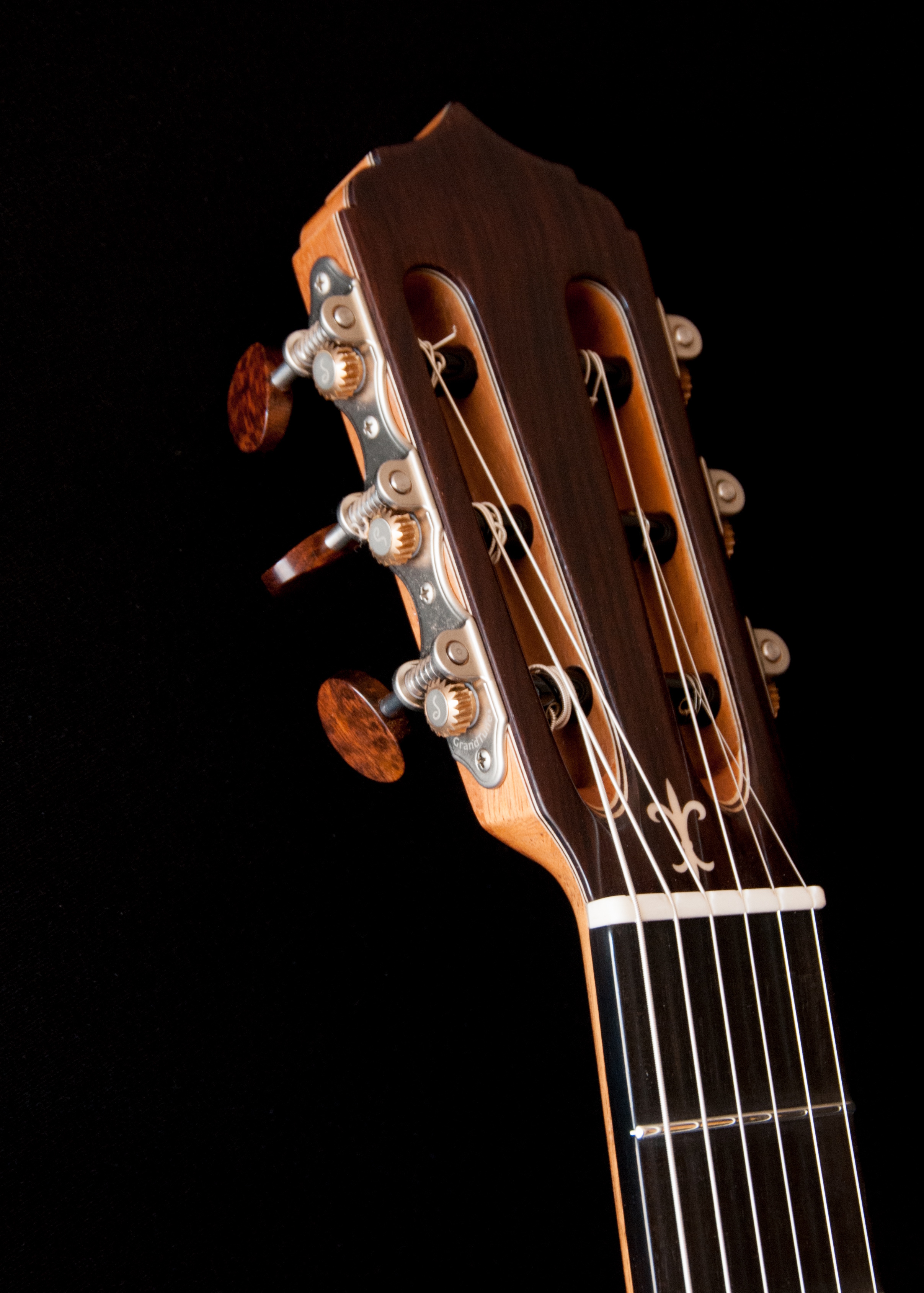
Six-String Classical Guitar
The Timeless Voice of Music
The six-string classical guitar is one of the most versatile and expressive instruments in Western music. With a rich history and unmistakable sound, it has become a constant presence in both the classical repertoire and traditional and popular music across different cultures.
Origin and Evolution
The modern form of the classical guitar was consolidated in the 19th century, largely thanks to the work of the Spanish luthier Antonio de Torres Jurado, considered the “father” of the contemporary classical guitar. He standardized the body size, introduced innovations in the internal structure (such as the fan bracing), and established the current tuning: E-A-D-G-B-E, from the sixth (lowest) to the first (highest) string.This six-string model came to be used by great composers and performers such as Francisco Tárrega, Heitor Villa-Lobos, Andrés Segovia, and more recently, names like John Williams and Julian Bream, who contributed to the appreciation and expansion of the instrument’s repertoire.
Sound Characteristics
The six-string classical guitar is known for its warm, round, and velvety tone, resulting from the use of nylon strings (or composite strings, with a nylon core and metal winding on the lower strings). It is an instrument that demands technical control and interpretative sensitivity, responding richly to variations in touch and dynamics.It is capable of performing multiple roles within a piece: melody, harmony, and rhythm. Polyphony is one of its greatest virtues, allowing the guitarist to execute independent lines with great fluidity.
Construction
The soundboard (usually spruce or cedar) is fundamental for sound projection, while the back and sides are typically made from woods such as rosewood, mahogany, or cypress, which contribute to the instrument’s balance and resonance. The fingerboard is often made of ebony, providing precision and durability.Each component is carefully chosen to ensure tonal balance, playing comfort, and durability, making the classical guitar a harmony of art, science, and tradition.
Musical Applications
Although deeply associated with the classical repertoire, from the Renaissance to contemporary music, the six-string classical guitar is also widely used in folk music, flamenco, choro, bossa nova, fado, and many other cultural expressions. Its adaptability and expressiveness make it a universal artistic tool.The six-string classical guitar is more than an instrument: it is an extension of the human voice and artistic sensitivity. Its history, beauty, and versatility continue to inspire musicians worldwide, proving that even with only six strings, it is possible to express infinite emotions.